Raising Generation Alpha: Why the Right School Between Ages 2.5 and 5 Matters More Than Ever
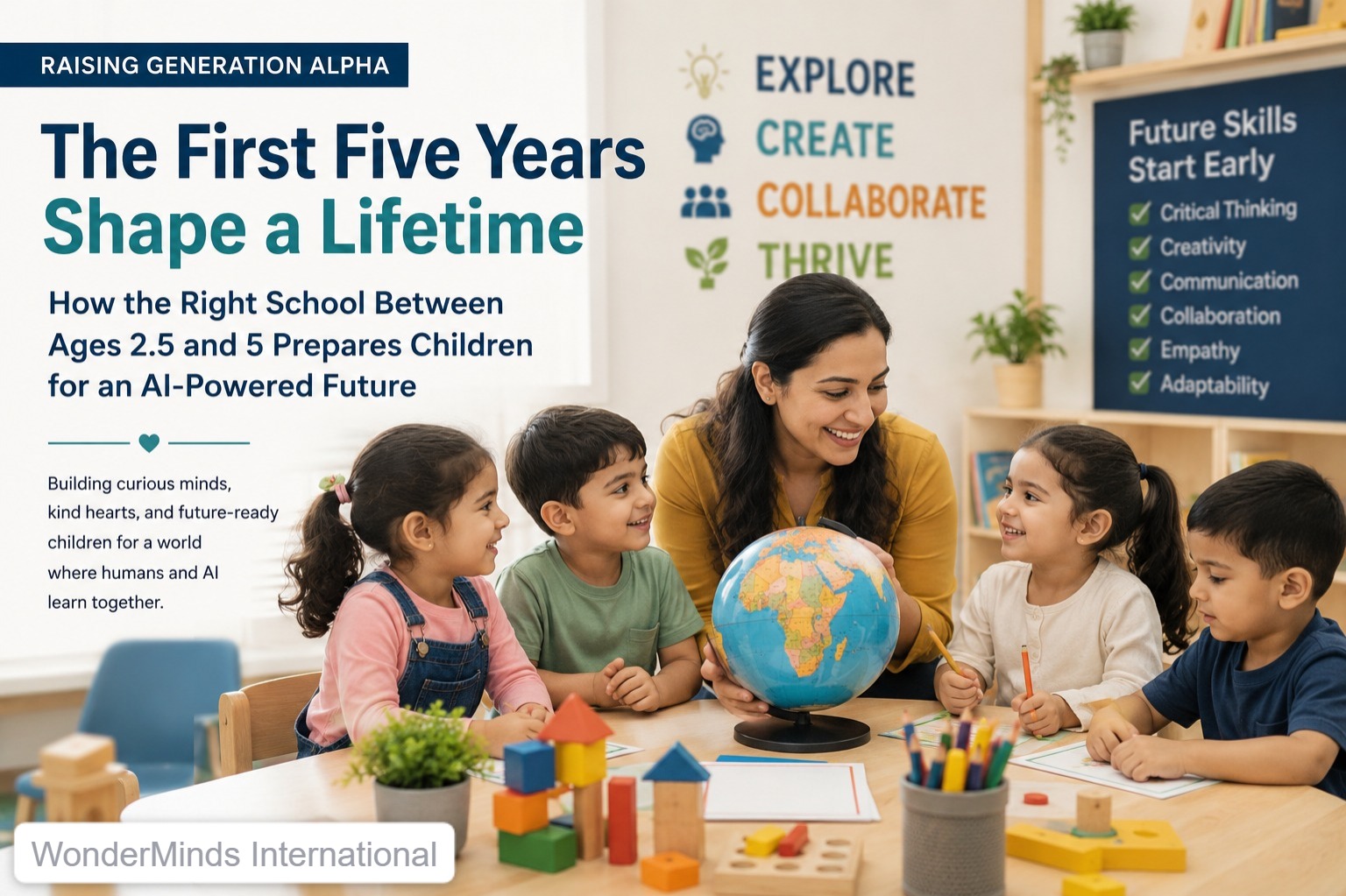
Today's children are growing up in a world shaped by artificial intelligence, automation, robotics, and rapidly changing technology.
The children entering preschool today belong to Generation Alpha — the first generation to be born entirely into a digital and AI-powered world.
By the time they enter adulthood, many of the careers they will pursue may not even exist today.
This raises an important question for parents:
How do we prepare children for a future we cannot yet predict?
The answer begins much earlier than many people realise.
It begins between the ages of 2.5 and 5 years, during one of the most important periods of brain development in a child's life.
The Early Years Build the Brain
Research shows that the first five years of life are critical for developing the foundations of learning, behavior, communication, and emotional wellbeing.
During these years, children develop:
- Language and communication skills
- Attention and concentration
- Emotional regulation
- Social interaction and friendships
- Problem-solving abilities
- Creativity and imagination
- Confidence and independence
- Self-control and resilience
These skills become the foundation for future academic achievement and lifelong success.
This is why choosing the right preschool or kindergarten is one of the most important investments parents can make.
Modern Schools Must Prepare Children for More Than Academics
In the past, success in education often focused on memorization and repeating information.
The world has changed.
Artificial intelligence can already answer questions, write reports, solve mathematical problems, and retrieve information within seconds.
The future workforce will require something different.
Generation Alpha will need to become:
- Creative thinkers
- Effective communicators
- Problem solvers
- Team players
- Adaptable learners
- Emotionally intelligent individuals
These are skills that technology cannot replace.
A good early learning environment helps children develop these abilities naturally through meaningful experiences and guided play.
What Children Really Learn in Preschool
Parents often focus on letters, numbers, and writing skills.
While these are important, children are learning much more during their preschool years.
Every day they learn how to:
- Wait patiently for their turn.
- Follow instructions.
- Work with others.
- Manage frustration.
- Solve disagreements.
- Ask questions confidently.
- Express their feelings appropriately.
- Keep trying when something feels difficult.
These skills form the basis of leadership, teamwork, resilience, and emotional intelligence later in life.
Why Play Matters in an AI World
As technology becomes more advanced, play becomes even more important.
When children build with blocks, engage in pretend play, explore nature, create artwork, or participate in group activities, they are developing skills that machines cannot replicate.
Through play, children develop:
- Creativity
- Flexible thinking
- Communication
- Negotiation skills
- Collaboration
- Decision-making
- Innovation
A child pretending to be a doctor, teacher, engineer, or chef is doing much more than playing.
They are practicing imagination, planning, language, social skills, and problem-solving.
Teachers Shape More Than Learning
Young children spend thousands of hours with their teachers during the early years.
Teachers help shape how children see themselves as learners.
Children who feel safe, supported, and understood are more likely to:
- Take healthy risks
- Ask questions
- Develop confidence
- Enjoy learning
- Build resilience
- Become independent thinkers
Children may not remember every lesson they were taught, but they often remember how their learning environment made them feel.
Preparing Children for Careers That Do Not Yet Exist
The goal of education is no longer simply preparing children for school.
It is preparing them for life.
The children in our classrooms today may become AI engineers, neuroscientists, digital creators, sustainability experts, healthcare innovators, or work in careers that have not yet been invented.
The schools that will best prepare children for this future are those that develop curiosity, creativity, communication, emotional intelligence, and a lifelong love of learning.
Because in an age of artificial intelligence, the most valuable skills may be the ones that make us uniquely human.
Choosing the Right Early Learning Environment
When selecting a preschool or kindergarten, parents should look beyond academics alone.
Ask yourself:
- Does the school encourage curiosity?
- Does it nurture creativity and problem-solving?
- Does it support emotional development?
- Does it promote communication and social skills?
- Does it prepare children for the future, not just for the next grade?
The answers to these questions may shape a child's journey for years to come.
At WonderMinds International, Al Khobar, we believe that early childhood education is about much more than preparing children for school.
It is about preparing them for life in an ever-changing world.
Because every child deserves the opportunity to develop the confidence, creativity, and skills needed to thrive in the future.
WonderMinds International — Where Every Mind Deserves To Learn Beyond Boundaries.
Dr. Mehvish Khan is a leading pediatric clinical neuropsychologist and neuroeducator, passionate about shaping how young minds learn, grow, and thrive.
Related articles
The Brain Behind Behavior™ #1: Inside the Preschool Brain — What Really Happens Between Drop-Off and Pick-Up?
A Pediatric Clinical Neuropsychologist explains what actually happens inside a preschooler's brain during a typical school day — and why those small moments shape lifelong learning.
Why the first 5 years shape a lifetime
Neuroscience shows the earliest years are the most critical for brain development. Here's how we make every moment count.
Raising bilingual kids: Arabic + English
Practical tips for parents supporting two languages beautifully at home and at school.